Friday, July 24, 2015

Education in El Salvador & Seeds of Hope (by Laurel)


To better understand our Salvadoran students back in Washington, we wanted to get a better understanding of the education system from which they come.  This has amounted to discussions with students, teachers, community leaders, union representatives and even El Salvador's Vice Minister of Education.  

The meeting with the Vice Minister on our second day in San Salvador was largely uninspired.  His overview of the government's education initiatives (better teacher training, improving infrastructure, increased spending for education in general) lacked substance and detail.  We knew that there would be a disconnect with what we would see and hear as our tour of the country continued.

The following day we met with the leaders of three teachers' unions who filled us in on the flip side of the Vice Minister's story.  The increase in government spending hasn't accounted for the increase in the number of students, so schools are actually making do with less money per pupil.  In cases where funding is there, schools may not receive it in a timely manner.  Significant "processing fees" are deducted from schools' funding.  New materials are provided, but without the support necessary to use them. And how absurd, they pointed out, to provide new computers to schools in areas without electricity!

It's difficult to tease apart how much of the disconnect between the national government and the local communities is the result of incompetence, corruption, or as the community leader of Amando Lopez suggested, a calculated plot to suppress the poor.   Whatever it is, the locals, at least in the communities that we visited, have lost faith in their government and are doing their best to fill in the gaps themselves.

The idea of "solidaridad" was evident in both of the rural villages that we visited.  By working and living in cooperatives,  community members are trying to take matters upon themselves.  Residents of Amando Lopez, for example, have worked together to establish and maintain a small library.  Running the school depends on an active parent/teacher association, and community leaders have figured out how to connect with NGOs to get funding for local projects. Elsewhere, in the village of San Luis in Morazan, one elderly resident spoke of the history of grass roots literacy programs in which residents who can read teach those who can't.  

Despite the inadequacies of the public education system, and along with the realities of poverty and insecurity, there's a lot of hope in these communities.  Hope is particularly evident in the dedicated teachers of Amando Lopez.  The Ministry of Education pays them about $68/month, but not always consistently.  They occasionally go several months without their salary, and when a check arrives, it may or may not account for back pay.  In the face of injustice, these teachers still show up.  They even take in students from outside their community - just because.  They stay focused on their work.

And so we made our rounds, from the fancy air-conditioned office of the Vice Minister to schools without plumbing in remote parts of the country.  We listened.  We asked good questions.  We tried to process the information overload.

As human rights advocate Jeanne Rikkers told us, the trick is to look for the small seeds of hope and find ways to water them so that they'll grow.  For example, Voices on the Border, our host organization, is paying a teacher's salary so that the school in Amando Lopez can offer 7th grade after 6th grade.  They have covered the cost of a substitute teacher so that the regular teacher can receive pay during her maternity leave.  They are also providing a grant to renovate the rundown library in San Luis.  Kudos to them for watering the seeds!

~Laurel

PS. I almost forgot to mention that our group team taught a 45-min English lesson to a group of 6th    graders in Amando Lopez!  Never mind the rudimentary facilities, these kids were smart, engaged and totally entertained by us Gringos!

 Day 2: Meeting with the Vice Minister of Education

Day 3: Meeting the leaders of the teachers' unions

The community library in Amando Lopez

"Welcome to Solidarity," the mural at the community library in Amando Lopez

Recruiting volunteer facilitators for "literacy circles" to help Salvadorans learn to read and write



Thursday, July 23, 2015

Home Stays, by Marina

History has never been my strongest subject. While I could memorize vocabulary words, mathematical equations, or the periodic table, I would always struggle to remember dates of important wars or historical events in great detail. The most informative part of this trip for me was having an opportunity to learn from the individuals who lived through a history and are living a current reality that I would only read about in books or newspapers.

Getting the chance to live with a host a family in Bajo Lempa really made the learning experience come to life. Waking up in the early hours of the morning, I found my host mom, Mabel, already at work cleaning corn to take to the "molina" by 5am before it got too busy. By 7am (the time at which I usually wake up to get ready for work), she had already made fresh tortillas and breakfast for the whole family and was taking care of the baby. We were told that everybody is up by 5:30 at the latest...starting your day after 6am is a sign of wealth.

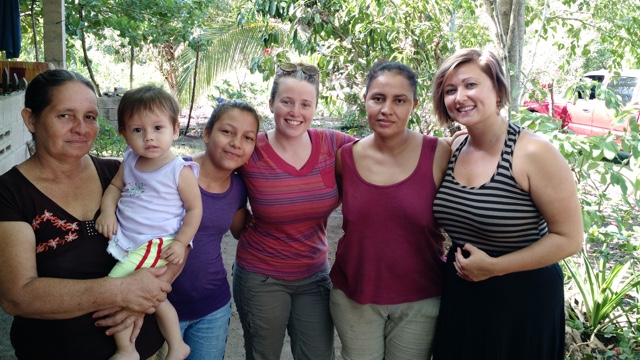
    Marina, Caitlin, and our host family

    Laurel, Sheryl, and their host family

In the U.S., we are saturated with tools of convenience. It was humbling to see that all the material things we are told we need, aren't all that necessary. A baby can sleep in a hammock, you can spend an evening playing cards on the floor, and do laundry in a concrete sink. Believe it or not, sleeping without a mattress isn't that bad. 

    Laundry day

    Delicious  breakfasts come out of this kitchen

    Marina & her host brother

    Lindsey and her host sisters

    Nap time

Thank you to the families that opened their doors and their hearts and welcomed us with open arms!

~ Marina

Thursday, July 16, 2015

From Lebanon to El Salvador, by Laurel


Besides learning more about where our students come from, a trip to El Salvador appealed because it was a chance for me to explore a completely new corner of the world--first time in El Salvador, first time anywhere in Central America.  After several years of back and forth with Lebanon, I was ready to shake up my travel pattern!

Now three days in, I'm surprised that things feel familiar.  In many ways, these two countries have a lot in common.  Lebanon might not be so far away after all. 

For starters, both are small countries with about the same number of people.  Geographically, there's a lot of diversity.  From beach to mountains, El Salvador and Lebanon have lots to offer in a tight space.

During our crash course in Salvadoran history with Miguel Ventura on our first day, other commonalities surfaced.  Time in these countries has been marked in massacres, assassinations and the comings and goings of refugees.  Recent civil war and on going traumatic fall out - check and check.   Both are learning that it's hard to move forward without coming to terms with the past. 

Digging a little deeper now in conversations with educators and activists, there are recurring themes: a security crisis, armed groups beyond government control, mass emigration, insufficient infrastructure, an intense religious dynamic, women's rights.  All this makes for a complex and overwhelming macro-problem, or as the Lebanese call it, "the situation."

The news coming out of both countries is grim, and makes folks back home wonder what I'm doing in these places.  The truth is there's a lot more behind the travel warnings and negative news reports.  Life in El Salvador and Lebanon goes on, so much so that it's surprisingly easy to feel at home.  People go to work and kids go to school.  There are tidy neighborhoods  and bustling city centers.  Grocery stores, movie theaters, gyms and car washes are filled with people going about their lives much as they do back home.  

That life carries on despite the situation speaks to the people's resilience and ability to adapt.  Time and again in Lebanon, at moments when it seemed the house of cards was about to fall, the Lebanese amazed me by quickly adjusting to the next level of dysfunction and carrying right on.  My sense after these past few days is that Salvadorans are equally flexible.  

This morning we wrapped up our three days in San Salvador and we're now headed to the mountains.  The scenery en route to Morazan reminds me of the Chouf.  If the similarities continue, the mountains will be my favorite spot.  I'm also hoping for more pupusas in the near future.  Pupusas are the new manoushi.  :)

L.A.


Wednesday, July 15, 2015

Day 2, by Sheryl

It was an amazing day. We packed in a lot starting with a visit to the church where Father Romero was assassinated. This was followed by an amazing discussion with Jeanne Rikkers, an expert in gang violence.  She told us about her personal experience with the negotiations between gangs and how the government has mishandled them and missed opportunities to make changes for the better. But she stays hopeful. I'm in awe of how someone who has seen so many setbacks and such misery can keep going. From this discussion we went to a meeting with the vice minister of education. It was uninspiring, just a lot of rhetoric about their vision. He is not the most inspiring speaker. From there we went to lunch and it was off to el Puerta del Diablo.  As if all that wasn't enough we had a great pupusa dining experience and finally, a few quiet moments looking at the city lights. 
Reflections: I feel like I've been here for weeks instead of only a little more than 24 hours. I've taken in so much information in such a short time. Certain themes, or words just keep coming up: martyrs, massacres, la puebla, la pobre and always, always Father Romero. Father Romero is El Salvador, and El Salvador is Father Romero.


Day 3, by Lindsey

Today we visited the Universidad Centroamericana and learned about the massacre there which ended up being the beginning of the end of the civil war.
We learned about a lot of martyrs at the Romero Center on campus. Our guide was a round exuberant storyteller.
Then we had a meeting with 3 leaders of teachers union who painted us the picture of the condition of the broken school system in El Salvador.
Finally we headed into the centro of San Salvador to see the National Cathedral and Oscar Romero's tomb. We also stopped by the Palacio Nacional. (photos below are a view from the Palacio and also inside the Palacio.)

Our last stop was the Museum of Images and Words which had some interesting exhibits on the role of women in the civil war, Prudencia Ayala (who ran for pres in 1930, first woman to do so and a suffragette), Radio Venceremos, as well as the indigenous uprising in 1932. (photo below is of a video editing machine that was used by the FMLN during the war.)
Now we have pack and we're off to Morazan tomorrow.

Tuesday, July 14, 2015

Orientacion historica

Day 1

After about 10 hours of travel, we finally arrived in El Salvador! There, we were greeted by our hosts from Voces en la Frontera: Jose, Eboni, and Jaime. At the guesthouse, after getting situated, our group was greeted by Miguel Ventura. Miguel is well known for his involvement in the political and social sphere of Morazan. As both a former priest who lived with the guerrillas and former governor of Morazan, he has been on the front lines of the changes that El Salvador has experienced since the late 20th century. He had the challenging task of providing us with the historical context of present day El Salvador and the various issues and challenges that the country continues to face.

The history of El Salvador's current problems can be traced back to the original conquest of the Americas and colonialism. Miguel argued that in many ways, the extermination of people has continued to be the most prominent way of maintaining power in the country, even to this day. Due to its oligarchical power structure, the government has managed to put down uprisings and suppress the spirit of the people to destroy the concept of "ser humano". Common themes throughout history include using violence as a form of control, exterminating people en masse, and maintaining a vertical hierarchy of rule.

It is hard to say what left us both overwhelmed and wanting more by the end of our first day. It could have been Miguel's personal stories of his time with the guerrillas and nearly becoming the third Jesuit priest to be assassinated while serving his community. Alternatively, it could have been that a painful and bloody history was summarized in a quick 2 hour lecture. Then again, we were also only operating on 3 hours of sleep.

"Los suenos" called us to bed early to give us more time to reflect on all that we learned in just 1 day.

~ Marina, on behalf of our group


Monday, July 13, 2015

Nos vamos!!

Welcome to the Traveling Teachers Blog 2015!! We all made it to the airport and are feeling good! Just missing my friend Carolyn from Kansas, also a teacher, who is meeting us in San Salvador. We are ready to learn more about the country where most of our student population is from, including a people's history, women-and youth-specific issues, natural beauty, and much more. Our host is the organization Voices on the Border. They've arranged an exciting, busy, and intriguing itinerary for us.

Check back in with us over the next ten days to find out what we're learning about El Salvador, how we can better reach our students, and all our adventures. We're already taking bets on how many of our  students we'll encounter. Last year's trip met a student in the San Salvador airport! Of course!

Michael and I are hoping for coffee in the morning (it is a coffee producing country after all) and we can't wait to climb a volcano. Sheryl hopes her stomach cooperates with her and looks forward to practicing her Spanish. Caitlin is pumped to learn about mental health approaches. Marina and Laurel are intrigued about what our homestays will be like (dirt floors? Outhouses?).

Leave a comment with any questions for us. What would you like to know about El Salvador?